Thursday, 1 December 2011

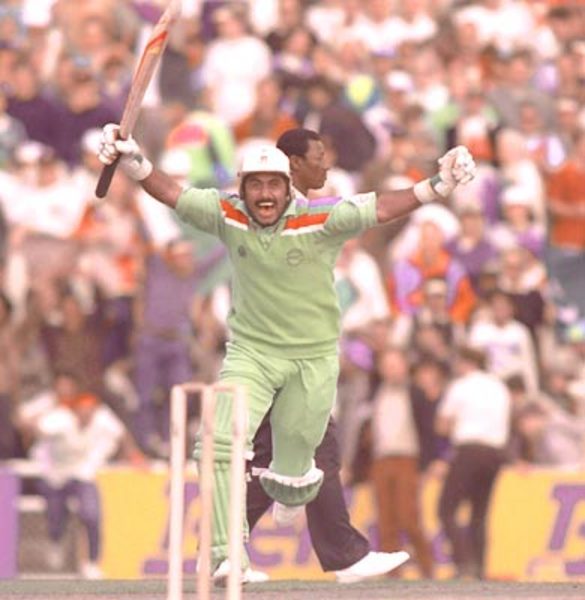
Javed Miandad

Javed Miandad Biography
Mohammad Javed Miandad Khan (Urdu: محمد جاوید میانداد) (born 12 June 1957), popularly known as Javed Miandad (Urdu: جاوید میانداد), is a former Pakistani cricketer who played between 1975 and 1996. He is Pakistan's leading run scorer in Test cricket. He has served as a captain of the Pakistan national cricket team. He is widely known for his big six against India in 1986 where 4 runs were required from 1 ball.[1] After his playing career, he has remained the coach of Pakistan cricket team at various occasions, as well as held positions in the Pakistan Cricket Board. He had three coaching stints with the Pakistan national team.Early life
Javed Miandad was born in Karachi, Sindh in 1957. Javed Miandad attended schools and college in Karachi. His parents moved from Ahmedabad, Gujarat, India.[citation needed] Javed Miandad is a Tyagi (Muslim).[2]
[edit]Career
Miandad made his Test debut against New Zealand at Lahore on 9 October 1976. He scored 163 in this match, to become the youngest player at the time to do so at an age of 19 years and 119 days.[3] In the same series he scored a double century, and on his way broke George Headley's 47 year record, to become the youngest player to achieve the feat.[4] Miandad made his One Day International debut against the West Indies at Edgbaston, Birmingham in the Cricket World Cup 1975. Interestingly, his last ODI was also a world cup match, in both innings he was run out and Pakistan lost the match. More, he scored 2 fours and 0 sixes and his strike rate was below 100 in both of his, first and last ODI innings.
Miandad's inclusion in the Pakistan team was itself an achievement. A formidable batting line-up of Majid Khan, Sadiq Muhammad, Zaheer Abbas, Asif Iqbal, Mushtaq Muhammad and Wasim Raja was hard to create any replacements, but Miandad's raw talent made it possible and he become an integral part of Pakistan's strong batting line.
Javed Miandad played 124 Test matches, batting in 189 innings. His aggregate of 8,832 Test runs is a Pakistani record. Even though his test career spanned 17 years, he failed to make it into the top-most category of batsmen with test aggregates of over 10,000 runs.[5] Miandad's 23 centuries and 43 fifties were Pakistani national records, until they were broken by Inzamam-ul-Haq. Miandad's Test career batting average of 52.57 is among the highest for Pakistani batsmen. He scored six double centuries which is the most by a Pakistani and 6th overall.He has honour of scoring centuries in both innings in the 1000th test match against New Zealand.[6] He made his highest score of 280 not out against India.
Javed Miandad is the first (and one of the only two, other being Sachin Tendulkar ) player to have played in six World Cups, the first six, from 1975 to 1996.
[edit]Coaching and commentary
As a coach, Javed Miandad guided Pakistan to test victories in the Asia Cup and in India during 1998-99 season, when Wasim Akram was captain. Miandad also later assisted with coaching Pakistani batsmen.[7]
Following this he was offered broadcasting and coaching positions in India.[8] Also in November 2010 it was being planned to give Miandad a role as a batting coach.
Javed Miandad
Javed Miandad
Javed Miandad
Javed Miandad
Javed Miandad
Javed Miandad
Javed Miandad
Javed Miandad
Javed Miandad's Famous SIXER @ Sharjah
Javed Miandad 271 vs NZ 3rd test 1988/89

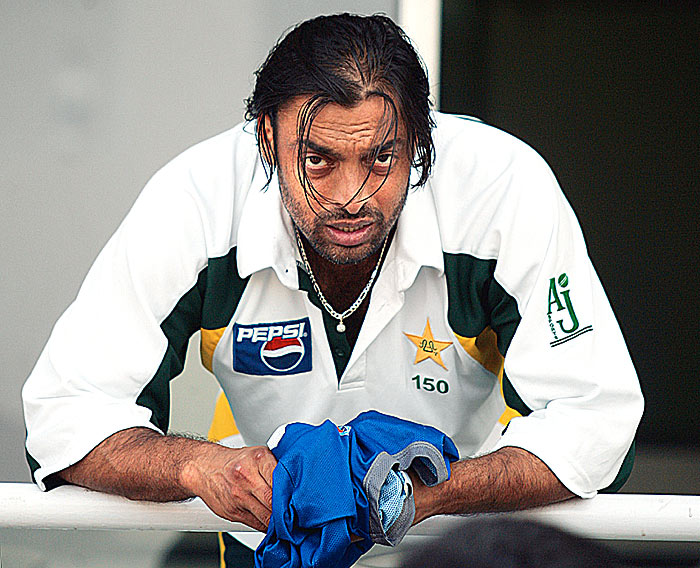
Shoaib Akhtar

Shoaib Akhtar Biography
Shoaib Akhtar (Punjabi, Urdu: شعیب اختر; born 13 August 1975) is a former Pakistani right arm fast bowler in cricket, who is regarded as the fastest bowler in the history of cricket. He set an official world record by achieving the fastest delivery, when he clocked in at 161.3 km/h (100.2 mph) in his bowling speed, twice at a cricket match against England.[1] His ability to bowl fast yorkers and quick bouncers have made him one of the best fast bowlers in cricket.
However, he has been involved in several controversies during his career, often accused of not being a team player. Akhtar was sent home during the Test match series in Australia in 2005 for alleged poor attitude. A year later, he was embroiled in a drug scandal after testing positive to a banned substance. However, the ban imposed on him was lifted on court appeal. In September 2007, Akhtar was banned for an indefinite period for his fight with Pakistan team mate and fast bowler Mohammad Asif.[2] On 1 April 2008, Akhtar was banned for five years for publicly criticizing the Pakistan Cricket Board.[3] In October 2008, the Lahore High Court in Pakistan suspended the five year ban and Akhtar was selected in the 15-man squad for the Twenty20 Quadrangular Tournament in Canada.[4] Pakistani judge, Rana Bhagwandas stated once that, Akhtar is a legend of Pakistan cricket.[5] He retired from international cricket after the 2011 World Cup.Early years

Akhtar was born at Morgah, a small town near Rawalpindi, Punjab in Pakistan to a Gujjar family of Kasana (gotra) tribe.[6] His father was a plant operator in Attock Oil Refinery, Morgah.[6] Akhtar started his studies at Elliott High School, Morgah and then took admission in the Asghar Mall College, Rawalpindi.[citation needed]
[edit]Career

[edit]International career
Akhtar's run of impressive performances started in the 1990s. In 1999, during a pre-World Cup series against India, he rose to prominence. It was followed by outstanding bowling performances in Sharjah and later in 1999 Cricket World Cup. His most significant performance was in India in 1999 when he captured eight wickets in the Asian Test championship match at Calcutta – including the wickets of Indian batsman Sachin Tendulkar and Rahul Dravid off successive deliveries. This was Akhtar's first encounter with Sachin Tendulkar, in which Akthar bowled him off the first delivery he delivered to the batsman.
In 2002, he was selected for the Pakistan team against Australia and achieved success. However he performed poorly during the 2003 Cricket World Cup and after the tournament he was dropped from the Pakistan squad. He was selected back into the Pakistan squad in the 2004 Test match series against New Zealand, but struggled in a losing Test series against India in 2004. The series ended with a controversy when he left the field citing an injury leading to suspicions by former Pakistan captain, Inzamam-ul-Haq, about his commitment to the team. As a result, his relationship with Inzamam-ul-Haq and former Pakistan coach Bob Woolmer deteriorated. A medical panel was set up by the Pakistan Cricket Board to investigate the nature of his injury, however Pakistan officials dispelled all suspicions.[7]
In 2005, Akhtar regained his reputation as a fast bowler for his side. Playing in a three Test home series against England, he made a series of impressive bowling performances. His effective use of slower deliveries proved to be unplayable by the English batsmen. Akhtar emerged as the highest wicket taker of the series with seventeen wickets. His comeback was also remarkable as prior to his return, he had been criticized from all corners-such as by the Worcestershire chairman John Elliot for his celebrity attitude and lack of commitment to team. His performance was also acknowledged by the English captain Michael Vaughan, who remarked "I thought he (Shoaib) was a big difference between the two teams".[8] He is also known as the only bowler ever to break the 100 mph barrier in cricket bowling history, with a delivery of 100.2 mph, and this delivery at stands as the fastest recorded to date.[1]
[edit]Struggle for form and consistent injuries (2007–2009)
On 29 October 2007, Akhtar made his return to cricket, from his 13 match ban and performed well, taking 4 wickets for 43 runs against South Africa in the fifth and deciding One Day International series in Lahore in Pakistan. Subsequently, he was included in the 16 man Pakistan squad for the 2007 tour of India, which he completed successfully without further incident and injury.
[edit]Rehabilitation and final years (2010–2011)
Akhtar made a return to international cricket albeit in the shorter format of the game. In May 2010, PCB named him in a list of 35 probables for the Asia Cup. On 15 June 2010, Akhtar made his return, taking 3 wickets for 28 runs in the first match of the Asia Cup against Sri Lanka.[9] He narrowly missed out a spot in the 2010 ICC World Twenty20 in place of the injured Umar Gul.
In July 2010, he was selected for the Twenty20 series against Australia but the selectors decided not to play him in the Test squad so that he would not get injured. He was subsequently selected for the ODI and Twenty20 series against England in September 2010.[10]
Akhtar returned to the national side representing the country against England in the Twenty20 International. He bowled an impressive spell and returned with figures of 2 wickets for 23 runs.[11] He continued to bowl well in the ODI series in the absence of regular fast-bowlers, Mohammad Asif and Mohammad Amir, who were suspended by the International Cricket Council amid allegations of Spot-fixing. Despite his relatively good bowling form, Pakistani coach Waqar Younis insisted that the bowling attack must not become reliant on Akhtar, as he is 35 years of age and fitness troubles continue to affect him.[12] Akhtar was selected for the tour of New Zealand and started his campaign off well with 3 wickets on Boxing Day in the first of two Twenty20 Internationals against New Zealand.
Akhtar was selected in Pakistan's 15-man squad to play in the 2011 World Cup hosted by Bangladesh, India, and Sri Lanka in February to March. During the tournament, he announced that he would retire from international cricket at the end of the World Cup.[13] In September, Akhtar released his autobiography, Controversially Yours.
Shoaib Akhtar
Shoaib Akhtar
Shoaib Akhtar
Shoaib Akhtar
Shoaib Akhtar
Shoaib Akhtar
Shoaib Akhtar
Shoaib Akhtar
Shoaib Akhtar at his Best
Shoaib Akhtar BBC Interview

Mohsin Khan

Mohsin Khan Biography
Mohsin Hasan Khan (Urdu: محسن حسن خان; born March 15, 1955, Karachi, Sindh) is a former Pakistani cricketer who played in 48 Tests and 75 ODIs from 1977 to 1986 mainly as an opening batsman.Life and Career
Playing in this role for Pakistan against India at Lahore in 1982-83, he scored 101 not out of Pakistan's second-innings total of 135/1. This is the lowest team score in Test cricket to have included a century.[1]
He was one of a minority of South Asian players to come to terms with conditions in Australia and England, scoring two consecutive centuries in Australia in 1983/4[2] and becoming the first Pakistani batsman to score a Test double century at Lord's, which he did earlier in 1982.[3] He retired from international cricket to pursue a film career.
He later married Bollywood movie star Reena Roy and had a short career as an actor in the Indian film industry. Movies he featured in includes Gunehgar Kaun, Laatsaab, Pratikaar, Fateh, Saathi, etc. He has since divorced Roy and remarried.
He now lives in Karachi, Pakistan. He has a daughter with Reena Roy, who now lives with her mother in India. He had named his daughter Jannat, but since then she is now called Sanam.
On 2 March, 2010 Pakistan have named Mohsin Khan as Iqbal Qasim's successor as chief selector of the national cricket team. He accepted the role turned down by fellow one-time opener Saeed Anwar. Mohsin is Pakistan's fourth chief of selectors in the past 12 months of 2009-10.
Mohsin Khan
Mohsin Khan
Mohsin Khan
Mohsin Khan
Mohsin Khan
Mohsin Khan
Mohsin Khan
Mohsin Khan
Whatever I am today is because of Pakistan: Mohsin Khan
Mohsin Hasan Khan Becomes Chief Coach for National Cricket Team

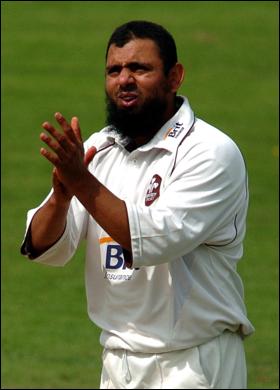
Saqlain Mushtaq

Saqlain Mushtaq Biography
Saqlain Mushtaq (Urdu: ثقلین مشتاق) (born December 29, 1976) is a Pakistani cricketer, regarded as one of the finest off spin bowlers of all time.[1] He is best known for pioneering the "doosra", which he employed to great effect during his career. Saqlain has not been active in international cricket since 2004.Career
Saqlain made his international debut in September 1995 playing against Sri Lanka at Peshawar.[2] He picked up four wickets at an average of 26.75 in the first test of the series.[3] The highlight of his Test career came in the away series against India in January/February 1999, where he achieved his first ten wicket haul in a test match.[4] In the first test, with India needing only 17 runs to win, Saqlain effectively sealed Pakistan's win by taking the wicket of Sachin Tendulkar who had scored 136.[5] He ended the series with twenty wickets at an average of 20.15, which earned him the Man of the Series award.[6][7]
[edit]Domestic career
Saqlain represented Surrey for eight successive seasons, from 1997 to 2004. However, his time there was interrupted and his international career with Pakistan effectively ended in 2004.[8]
In August 2005, he played his first match after recovering from injury against Bangladesh A, and took 4-87 from 35 overs bowled over two innings.[9] However that same week, in his return to the County Championship, he conceded 110 off 28 overs against Gloucestershire, taking just one wicket.[10]
In February 2006, he signed for Ireland for the C&G Trophy, along with fellow team mate Abdul Razzaq.[8][11]
Later in February 2007, Sussex announced that Saqlain had signed a two-year contract with them. His initial requirement was to cover for fellow Pakistanis, Mushtaq Ahmed and Rana Naved-ul-Hasan who were part of Pakistan's World Cup campaign.[12] On 26 September 2007, Saqlain was released by the county on his request. On 8 October 2007 Saqlain was re-signed by Surrey.[13]
On 28 October, according to Cricinfo, he was released by Surrey.
In April 2009 he joined Old Whigiftians CC[14] to play in the Surrey Championship. He took 64 wickets in his first season, including five 5 wicket hauls to earn Whits promotion to the first division. He was also involved in the youth game setup. In 2010, after relocating to Leicestershire, he joined Syston Town Cricket Club, playing in the Everards County League.[15]
In late 2010, he was training in Taunton at the facilities of Somerset County Cricket Club, whom he has now joined as a temporary spin-bowling coach for the 2011 Caribbean Twenty20 competition.[16]
[edit]Playing style

Saqlain is credited with the invention of the "doosra", an off-spinner's delivery which is bowled with an action very similar to that of an off-break.[8] However, it spins in the opposite direction (i.e. from the leg side to the off side), easily confusing batsmen, making it a very effective weapon.[17] Saqlain became well known for this variation ball, which was integral to his success, although he received criticism for overusing it.[2]
His other variation was the arm-ball, which again uses a similar action to the off-break, but causes the ball to go straight on without turning.[citation needed]
During his time at Surrey, Saqlain worked on developing new deliveries which he called the "teesra" and the "chotha".[18] However little else is known about these deliveries.
[edit]Records and achievements

Saqlain was selected as a Wisden Cricketer of the Year for 2000.[2]
A statistical analysis conducted by Wisden in 2003 revealed Saqlain as the all-time greatest ODI spinner, and sixth greatest of all ODI bowlers.[1]
Was the fastest to reach the milestones of 100, 150, 200 and 250 wickets in ODIs.[19]
He was the first of only two spinners to have taken a hat-trick in an ODI (the other being Abdur Razzak), and the second of only four bowlers to have taken two ODI hat tricks (Wasim Akram, Chaminda Vaas and Lasith Malinga being the others),[20] the second of which was only the second hat-trick in a World Cup match.[21][22]
[edit]Personal life

After marrying a British citizen, Saqlain gained a British passport, which made him eligible to play for England after a four-year qualification period that ended in April 2008.
Saqlain Mushtaq
Saqlain Mushtaq
Saqlain Mushtaq
Saqlain Mushtaq
Saqlain Mushtaq
Saqlain Mushtaq
Saqlain Mushtaq
Saqlain Mushtaq
Saqlain Mushtaq Doosra against Australia...Amazing bowling
Saqlain Mushtaq explains the Doosra

Abdul Razzaq

Abdul Razzaq Biography
Abdul Razzaq (Urdu: عبد الرزاق, born 2 December 1979) is a Pakistani right arm fast-medium bowler and a right-handed batsman, who is currently representing the Pakistan cricket team. He emerged in international cricket in 1996, when he made his One Day International debut against Zimbabwe at his home ground in Gaddafi Stadium in Pakistan, a month before his seventeenth birthday. He has played over 200 ODIs and nearly 50 Tests for Pakistan
Skills in cricket

Originally a fast bowler, Razzaq's batting has improved throughout the years and he has been recognized as an all-rounder.[1] He is best known in cricket as an aggressive batsman and has the ability to score quick runs.[2] This versatility has given him the talent of batting and bowling at every position on the team. He is also one of Pakistan's most effective hitters of the cricket ball.[3]
Despite his qualities, he has been criticized by some, for his batting techniques in Test matches.[who?] Another being that he averages almost 37 with the ball. However he has excelled in the One Day International arena, with several excellent performances. He is also an accurate fast bowler who has been successful against the batting opposition. Razzaq claims to have learned many things while playing under former captain Wasim Akram during the 1990s and early 2000.[4] One of the things that he learned, was his quick-arm bowling action, which makes it hard for the batsman to predict at what speed the ball is going to be delivered.
[edit]Career

[edit]Early career
Razzaq made his One Day International debut in November 1996, against Zimbabwe, but had to wait just over three years to make his Test cricket debut for Pakistan, eventually doing so against Australia in Brisbane on November 1999. In the 1999-2000 Carlton and United Series, he rose to fame and was named man of the series for his all round performance. During a match in Hobart against India, Razzaq scored a half century and took five wickets. In the same tournament, he hit former Australian fast bowler, Glenn McGrath for 5 fours, which totaled to 20 runs in one over.
[edit]1999 Cricket World Cup
Razzaq became a regular member of his national side during the 1999 world cup held in England. During the event, he got the attention of selectors as he performed well both with the ball and bat. His brilliant performance with the bat came in the group match against Australia, where he went on to score his first half century making 60 runs in a long and stable partnership with Inzamam-ul-Haq, which helped Pakistan reach a defendable target of 275.[5] Pakistan went on to win the match by ten runs and as a result qualified for the Super Six stage.[5] With the ball, he made a brilliant performance against the tough West Indian cricket team by taking three wickets for 32 runs having three maiden overs, which proved decisive for Pakistan at Bristol.[6]
[edit]2000 Carlton & United Series
Razzaq's other impressive performances came during the Carlton & United Series at Australia in a tri-nation tournament involving Pakistan, Australia and India in 2000. Razzaq achieved the man of the series award for his best all round performances, especially in a pre-finals match against India, where he scored 70 not out with the bat and took 5 wickets for 43 runs, thus becoming the fifth all-rounder to have scored a half century and take five wickets in a match; the other four players being Sachin Tendulkar, Kapil Dev, Ian Botham and Sourav Ganguly; Shahid Afridi subsequently achieved the feat.
In the first match of the series against Australia, he took 4 wickets and played an important role for Pakistan helping them to successfully defend a very low target of just 187 runs at Brisbane. In the third match of the series, Razzaq came into prominence after hitting five consecutive boundaries in the fifth over of Australian pacer Glenn McGrath. Eventually Pakistan was defeated in the finals by Australia but Razzaq was named player of the series for his all-round performance.[7]
In 2000, Razzaq became the youngest cricketer in the world to take a Test cricket hat trick in a match against Sri Lanka. He has scored three centuries and twenty two fifties in One Day International matches. His highest score was 112 runs, against South Africa in 2002, where he shared a partnership of 257 runs with Pakistani batsman Saleem Elahi. His second century was scoring 107 runs not out in a match against Zimbabwe in 2004. During this match, he saved Pakistan from a disastrous start and eventually won them the match. His first fifty came in 90 deliveries, before accelerating in the second fifty runs, which was scored in just 21 balls. Also in 2003-2004, he scored 89 runs from 40 balls against New Zealand, whose captain Stephen Fleming called him the "best hitter" in the world.[8] In January 2005, He was involved in the ACC Asian XI that took on the ICC World XI in the World Cricket Tsunami Appeal charity match at the Melbourne Cricket Ground in Australia.
As a fast bowler, Razzaq experienced a steady decline in speed and performance during the 2003 cricket World Cup and 2004. In this period he was used as a supporting bowler. However, from 2005 to the end of 2006, he regained his speed and he has won many matches for Pakistan with his bowling. His best bowling figures in a One Day International match is 6 wickets for 35 runs. His other excellent performance arrived against Sri Lanka at Sharjah in 1999, where Pakistan were all out for 196 runs and he took 5 wickets for 31 runs to draw the match. During the 2005-2006 Test match series against India, Razzaq took 9 wickets and scored 205 runs in two Test matches he played, which resulted in an improvement of his performance. His batting remained generally consistent from 2000 to 2006, although his place on the Test team was never secure.
Razzaq's place in the Pakistan national team has been marred by injuries and absences. In 2005 it was revealed that he was suffering from an addiction to spinach, which was causing him to suffer from nausea and sickness while playing. This led to him being known as 'Popeye' by his team mates.[9] In 2007, a poor performance in a series with both the bat and ball, in a match against South Africa, accompanied with an injury that forced him out of the 2007 cricket World Cup, saw him dropped from the 2007 World Twenty20, a decision that received widespread criticism from cricket individuals.
Abdul Razzaq
Abdul Razzaq
Abdul Razzaq
Abdul Razzaq
Abdul Razzaq
Abdul Razzaq
Abdul Razzaq
Abdul Razzaq
Abdul Razzaq 88 vs India 2nd ODI 2005
Abdul Razzaq 62 runs from 30 balls; 3 fours and 5 sixes! part 1 of 2

Sohail Tanvir

Sohail Tanvir Biography
Sohail Tanvir (Punjabi : سہیل تنویر, born December 12, 1984 in Rawalpindi, Punjab) is a Pakistani cricketer, who has gained repute for his unorthodox left arm bowling action and particularly for the success it has gained him in the Twenty20 format of the game
International career

An allrounder, he is a hard-hitting left-handed batsman and an unorthodox left-arm fast-medium bowler who also bowls occasional left-arm orthodox spin. Despite not having taken a single wicket during his ten Twenty20 matches domestically, he was selected for Pakistan's squad for the inaugural World Twenty20 after Shoaib Akhtar was sent home. He made his Twenty20 debut in the tournament, and took six wickets in six matches, with best bowling figures of 3 for 31 in four overs against Australia. Though considered an allrounder, Tanvir did not get a chance to bat in the tournament until the final, where he made his first international runs, with a six off his first ball, aiding Pakistan back into the game.
After impressing in the ICC World Twenty20, he was selected to play in the ODI series against South Africa in October, 2007. He was then selected for the tour of India, and took eight wickets in the ODI series. He also took part in the Test series that followed, making his debut in place of the injured Umar Gul. On debut at the Feroz Shah Kotla in Dehli, he took three wickets which included his first international Test cricket causality Sourav Ganguly and Rahul Dravid. In Asia Cricket Cup, June 2008, Pakistan played their first game against Hong Kong at Karachi. In that match, Pakistan's top order struggled to get grips with Hong Kong bowlers before Sohail Tanvir set up a 100 run stand along with Fawad Alam for the 8th wicket. Sohail scored his maiden ODI 50 in that match. He scored 59 off just 55 balls which took Pakistan to a respectable score of 288. After that, in the match vs. Sri Lanka, Tanvir took his first 5 wickets haul. He ended at 5/48 in 10 overs. After the 2009 ICC World Twenty20
[edit]Knee injury (2010)
Shortly after the World Twenty20 Tanvir was on a one-year break because of injuries. He missed the tour of New Zealand in November 2009, the controversial tour against Australia in January 2010. He also missed the chance to participate for Pakistan in the 2010 ICC World Twenty20 the 2010 Asia Cup and he missed the tour of England in August 2010. He recovered from injury in October 2010 and was selected to participate in the test series against South Africa under new captain Misbah-ul-Haq[2] The doctors however advised rest for Sohail Tanvir to help him recuperate fully from the new injury[3] He completely recovered from his knee injury by December and was selected for all three formats against New Zealand. He gave insights into his injury and stated at one point he couldn't even walk and that doctors thought he would really struggle to walk. However, he recovered really quickly after that and the surgery he had in Australia in January paid off.[4] At the last minute of the team departing for the New Zealand tour Tanvir was replaced because the selectors thought he was not fully fit.[5] After missing the Twenty20 Internationals the selectors recalled Tanvir after he had proved his performance in domestic games coupled with poor performances from a depleted Pakistan bowling attack.[6]
[edit]Return and World Cup selection (2011)
Despite being back in the team for the two-test series and the final Twenty20 Tanvir wasn't selected, despite not having played an international match in thirteen-months he was named in Pakistan's 15-man World Cup Squad he finally returned to the national team in the first ODI against New Zealand after Pakistan elected to bat Tanvir scored six-runs as Pakistan were bowled out for 124, however Tanvir also took one-wicket it would turn out to be Pakistan's only wicket of the match as New Zealand won by nine-wickets.[7]
Sohail Tanveer was ruled out of World Cup 2011 due to failing to complete a full rehabilitation from surgery for a knee problem that has dropped him two years.[8]
Sohail Tanvir
Sohail Tanvir
Sohail Tanvir
Sohail Tanvir
Sohail Tanvir
Sohail Tanvir
Sohail Tanvir
Sohail Tanvir
Sohail Tanvir 4-53 vs India 5th ODI 2007
Sohail Tanvir 2 Wickets Against India 3rd ODI 2007

Inzamam-ul-Haq

Inzamam-ul-Haq Biography


Inzamam-ul-Haq (Saraiki, Punjabi, Urdu: انضمام الحق; born 3 March 1970[1]), also known as Inzamam, nicknamed Inzy, is a former Pakistan international cricketer who was national captain between 2003 and 2007. He is a right-handed batsman who has been regarded as one of the greatest batsmen of his era. He rose to fame in the semi-final of the 1992 world cup, in which he scored 60 of 37 balls against a potent Kiwi side.[2]
On 5 October 2007, Inzamam retired from International cricket following the second Test match against South Africa, falling three runs short of Javed Miandad as Pakistan's leading run scorer in Test cricket. Following his retirement, he joined the Indian Cricket League, captaining the Hyderabad Heroes in the inaugural edition of the Twenty20 competition. In the ICL's second edition, he captained the Lahore Badshahs, a team composed entirely of Pakistani cricketers.
Career

[edit]One Day International cricket
Inzamam made his One Day International (ODI) debut in a home series against West Indies in 1991, and made a good start to his career by scoring 20 and 60 runs in two matches against West Indies. This was followed by 48, 60, 101, and 117 runs against Sri Lanka.
Handpicked by former Pakistan captain Imran Khan for the 1992 Cricket World Cup in Australia and New Zealand, 22-year-old Inzamam was relatively unheard of before the tournament. To the surprise of many he was persevered with throughout the tournament, coming in at various positions in the batting line-up, despite not being very successful early on. Yet it was his performances at the most crucial stage of the competition that made fans and summarisers take note. Inzamam rose to fame in Pakistan's dramatic semi-final against New Zealand at Auckland. With his side in a precarious position, chasing 262 against an impressive New Zealand side, he hit a fiery 60 run innings from just 37 balls to rescue his side and guide them into the final.[3][4] The innings was regarded as one of the finest World Cup performances.[5] He hit a massive six in that match which was described by David Lloyd as the shot of the tournament.[citation needed]
Inzamam made an equally vital contribution in the final of the World Cup, scoring 42 runs off just 35 balls, helping Pakistan reach a score of 249 after a sluggish start.[6] These innings established Inzamam's billing as a big-game player, although he was unable to replicate his World Cup success in later tournaments.
Inzamam regard his best least highlighted innings of 90 not out against west indies when Pakistan won their first ODI in the West Indies on 27 March 1993.[7]
In total, Inzamam set a record for scoring the most half centuries in One Day Internationals, 83 – though this is now surpassed by Sachin Tendulkar.[8] He also became the second batsman to score 10,000 runs in One-day Internationals (again after Tendulkar) and was named in the ICC World XI for both Tests and One-day Internationals in the 2005 ICC Awards. In his final ODI for Pakistan, playing against Zimbabwe in the 2007 Cricket World Cup, he took three catches whilst fielding, including the last one of the match, ending his One Day career.[9]
[edit]Test cricket
Inzamam made his Test debut in 1992 against England at Edgbaston. However, he got little opportunity to make an impact in that match – he was not out with a score of 8. However, in subsequent matches he demonstrated vulnerability against swing bowling which resulted in him being dropped for the final Test of the series after averaging a lowly 13.20 runs per innings. Pakistan went on to secure a famous win in the match, taking the series 2–1.[10]
After the England series, Inzamam aimed to establish himself in the Test side and he achieved this brilliantly, helping his side to many memorable victories.[11] One of particular note came against Australia in Karachi, 1994, when he made 58 not out with the tail and helped Pakistan to a one-wicket victory and a 1–0 series win. As well as helping his side to become the top-ranked side in the world for a brief period. He achieved personal success by becoming ICC's number one ranked batsman in 1995[12] He later went on to reclaim top spot in the rankings in 1997. He remained amongst the top 20 ranked batsmen up until his retirement. He was the number one batsman in the world three times and held the title of the 3rd best batsman several times in his career including an extensive run from 2004–2006 ,[13] the last time being after his twin fifties at Lords against England in 2006.[14] The tour of England in 1996 was a particular success for both Inzamam and Pakistan, where Inzamam transformed his batting against seam bowling, averaging 64 runs per innings, with scores of 148, 70, 65, and 35.
His Test career highlights include 329 against New Zealand in Lahore in the 2001–02 season, which is the second highest Test score by a Pakistani and the twelfth highest overall. He also scored a century (184 runs) in his 100th Test, becoming only the fifth player to do so (after Colin Cowdrey, Alec Stewart, Gordon Greenidge and Javed Miandad; Ricky Ponting subsequently emulated the feat). Inzamam made a century in each innings of the second Test match against England in 2005, to become Pakistan's leading centurion with 24 centuries, breaking Javed Miandad's record. His 25th century in the 2nd Test against India on 22 January 2006 made him the 10th player to score 25 or more centuries. He also managed 138 not out when the team was on the brink of a humiliating defeat against Bangladesh, eventually saving the Test match and leading his team to victory. His 92 not out against South Africa in late 2006 again showed his ability to bat in a crisis in a match winning manner.[15] He scored twin half centuries when all appeared lost to draw the first test in Mohali against India in 2005,[16] and also scored 184 runs in his 100th test match[17] in the same away series causing the series to be drawn.[18] He still holds the record for most consecutive half centuries against a country with nine in nine innings against England. This streak started from 31 May 2001 and lasted till 13 July 2006.[19] He scored a century and a half century at Lords in 1996.[20] His 118 against Australia in Hobart almost won the test for Pakistan but Adam Gilchrist's match winning 149 not out made the difference.[21] His average in matches won is second only to Donald Bradman and Kumar Sangakkara.[22]
After announcing that he will retire after the second Test against South Africa, at the stadium where he made his international debut,[23] Inzamam needed 20 runs to surpass Javed Miandad for the record of most runs for a Pakistani Test cricketer.[24] After falling for 14 in the first innings, he was dismissed for 3 in his final innings by Paul Harris, out stumped,[25] leaving him three runs shy of the record. He needed only 70 more career runs for a batting average of 50.
[edit]County cricket
Inzamam made his debut in English county cricket in August 2007 at the age of 37. He joined Yorkshire County Cricket Club[26] as a replacement for Younus Khan who left to play for Pakistan in the 2007 ICC World Twenty20. He was disappointing on the whole, making eight on debut at Scarborough's North Marine Road against Warwickshire before making nine and seven in his opening Pro40 games.
Inzamam-ul-Haq
Inzamam-ul-Haq
Inzamam-ul-Haq
Inzamam-ul-Haq
Inzamam-ul-Haq
Inzamam-ul-Haq
Inzamam-ul-Haq
Inzamam-ul-Haq
Inzamam Ul Haq 123 vs India 2004
Inzamam-Ul-Haq 130 vs New Zealand 2nd test 2000/01